
From Draft to Distribution: Why Research Publishing Needs End-to-End Workflow Discipline
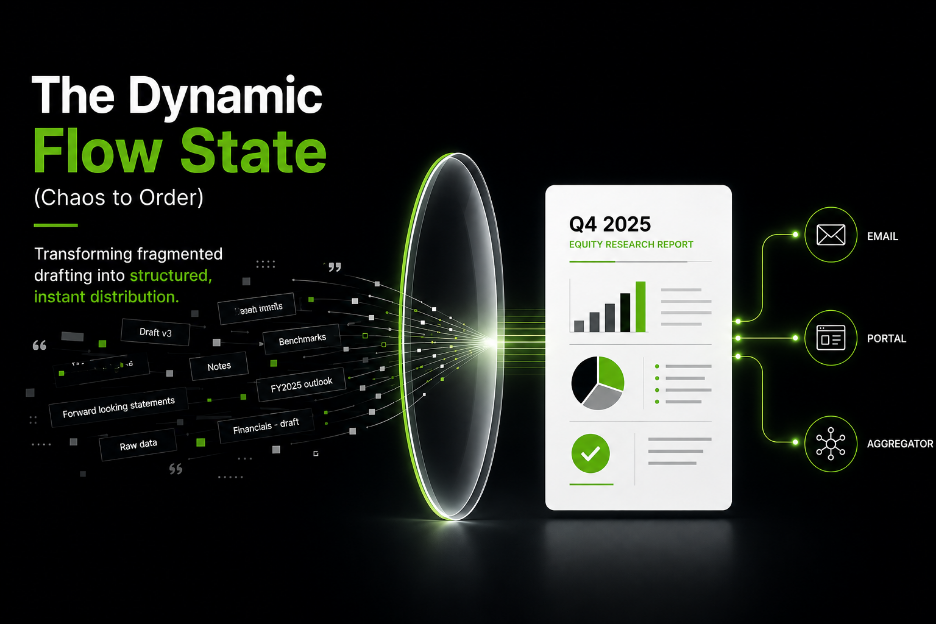
The cost of equity research is rarely measured at the point where it is actually incurred.
Most firms can identify analyst compensation, market data spend, and technology budgets. Far fewer can explain what it costs to move a single research note from first draft to client delivery.
That gap matters.
A report may take hours to write, but its production cost continues to rise through formatting, review, disclosure checks, approval, conversion, distribution, and follow-up. Much of that work is absorbed quietly by analysts, editors, compliance teams, research operations, and sales support.
The result is a research P&L that often looks more efficient than it really is.
For Heads of Research and research COOs, the question is no longer whether publishing workflows could be tidier. It is whether the current cost-per-note is sustainable as budgets tighten, coverage expectations rise, and clients demand faster, more relevant delivery.
Research costs continue after the analyst finishes writing
The analyst’s draft is only the start of the production cycle.
Before publication, the document may need financial tables updated, charts reformatted, disclosures inserted, branding checked, comments reconciled, and multiple approvals secured. It may then be converted into several formats and distributed across email, websites, portals, and third-party research platforms.
Every manual intervention adds cost.
An analyst rebuilding a table is not performing analysis. A compliance professional checking the same disclosure logic repeatedly is not exercising judgement where it matters most. A research operations team recreating recipient lists is consuming headcount on work that does not improve the underlying investment view.
These costs rarely appear as a separate line item. They are hidden inside salaries, overtime, delayed publication, and constrained research capacity.
That is why cost-to-publish is a more useful management measure than document volume alone.
Fragmented accountability creates an invisible production tax
Research publishing often spans several teams, but ownership is rarely continuous.
The analyst owns the content. An editor may own presentation quality. Compliance owns regulatory checks. Research operations may manage publication. Sales or client service teams may influence distribution.
When those stages sit in separate systems, the gaps between them become expensive.
A document should not move forward simply because someone forwarded an email. Yet in many firms, approval still depends on inboxes, attachments, informal reminders, and individual knowledge of what happens next.
This creates an invisible production tax through:
- time spent locating the latest version;
- duplicated checks across teams;
- avoidable rework after late-stage changes;
- delays while responsibility is unclear;
- manual rebuilding of content for different delivery channels.
The larger the research operation, the more that tax compounds. A small inefficiency repeated across hundreds or thousands of notes becomes a material operating cost.
The research lifecycle should be managed as one economic process
The economics of research publishing improve when the lifecycle is treated as one connected process rather than a sequence of administrative tasks.
That lifecycle begins with drafting and collaboration. It then moves through editorial review, compliance checks, approval, publishing, distribution, client delivery, and readership analysis.
Each stage affects the economics of the next.
Poor version control increases review time. Inconsistent templates increase formatting effort. Late disclosure changes create rework. Disconnected distribution forces teams to rebuild recipient logic after the report is already approved.
The commercial implication is straightforward: cost is created at the hand-offs.
A disciplined operating model reduces those hand-offs, preserves context as the note moves between teams, and makes it easier to identify where time and headcount are being consumed.
This is not simply workflow improvement. It is production-cost control.
Compliance design has a direct effect on cost-per-note
Research compliance is essential, but the way it is operationalised can either protect margins or erode them.
Manual disclosure selection, repeated document checks, and inconsistent approval routing increase the effort required for every publication. They also create concentration risk around the people who understand the process well enough to keep it moving.
A controlled compliance workflow changes the cost structure.
Analec Resonate supports configurable approval stages, document checks, disclosure and disclaimer management, analyst or regulatory sign-offs, restriction controls, and date- and time-stamped audit trails.
These controls are designed to make compliance part of the publication process rather than a separate exercise performed at the end.
The value is not the elimination of compliance judgement. It is the reduction of repetitive administrative work around that judgement.
When routine checks are embedded into the process, compliance teams can focus more of their time on genuine exceptions and higher-risk publications.
Distribution inefficiency wastes the investment already made in research
A research note that reaches the wrong audience is not merely a distribution problem. It is wasted production spend.
By the time a note is published, the firm has already paid for analyst time, data, editing, review, compliance, and production. If the content is then sent through broad, poorly maintained lists, much of that investment fails to generate meaningful client engagement.
For equities research, Resonate can support preference-based distribution using criteria such as company coverage, sector, analyst, country, market capitalisation, or research product.
It also supports branded email delivery, PDF and HTML formats, contribution to third-party platforms using RIXML, and controlled digital access.
The economic gain comes from connecting final approval to targeted delivery.
The research team produces the note once. The platform manages how it is packaged and delivered across selected channels. That reduces repeated production work while improving the probability that the content reaches clients for whom it is relevant.
Resonate changes the economics of research production
Analec Resonate brings authoring, workflow control, compliance management, publishing, and distribution into one research production environment.
Its role is not simply to help firms publish faster. It is to reduce the amount of paid human effort consumed between the investment idea and the final client delivery.
The platform supports:
- Microsoft Office-based authoring;
- centralised version control;
- reusable content components;
- automated document production;
- configurable approvals;
- audit trails;
- branded digital delivery;
- readership tracking.
This matters because research departments rarely have the option of adding headcount each time output grows.
A scalable research operation must increase publication capacity without allowing production effort to rise at the same rate. That requires fewer manual rebuilds, fewer avoidable checks, and less dependence on individual workarounds.
Implementation still requires discipline. Templates must be standardised. Approval logic must reflect actual governance. Legacy systems may need integration. Analysts and reviewers must adopt the process consistently.
Technology does not remove those constraints. It makes them visible and manageable.
Research publishing is now a P&L question
Excellent research deserves excellent delivery. It also deserves an operating model that does not consume more resources than the research is worth.
The strongest case for end-to-end publishing discipline is not that it creates a cleaner process. It is that it lowers the hidden cost of producing, approving, and distributing each note.
Analec Resonate helps research firms manage that cost across the full lifecycle, from authoring and compliance to publication and targeted delivery.
Disciplined delivery is part of the research product itself. Increasingly, it is also part of the research department’s financial viability.
FAQs:
1. What is the true cost of publishing an equity research note?
The true cost includes more than analyst time. It also covers formatting, editorial review, compliance checks, approval routing, document conversion, distribution, and readership tracking. When these stages rely on manual hand-offs, the cost-per-note can rise without appearing as a separate line item in the research department’s budget.
2. Why is cost-per-note an important metric for research firms?
Cost-per-note helps research leaders understand how much operating effort is required to produce and deliver each publication. It provides a clearer view of productivity than publication volume alone because it captures the hidden time spent on rework, version control, approvals, compliance administration, and distribution.
3. How do fragmented research publishing workflows increase costs?
Fragmented workflows create delays, duplicated checks, version confusion, and repeated production work. Analysts, editors, compliance teams, and research operations staff may spend time locating documents, reconciling changes, or rebuilding content for different channels. These inefficiencies consume valuable capacity without improving the quality of the investment research.
4. How can research workflow automation reduce the cost of publishing?
Research workflow automation can reduce repetitive manual work by standardising templates, controlling document versions, routing approvals, applying compliance rules, and connecting publication with distribution. The aim is not to remove professional judgement, but to ensure that skilled employees spend less time on administrative tasks and more time on analysis, review, and client service.
5. How does Analec Resonate support more efficient research production?
Analec Resonate supports the research lifecycle through Microsoft Office-based authoring, centralised version control, configurable approval workflows, disclosure management, audit trails, automated document production, branded digital delivery, and readership tracking. By connecting these activities within one environment, Resonate helps firms reduce avoidable production effort and manage the economics of research publishing more effectively.