
How Research Teams Can Improve Report Quality Through Better Workflow Controls
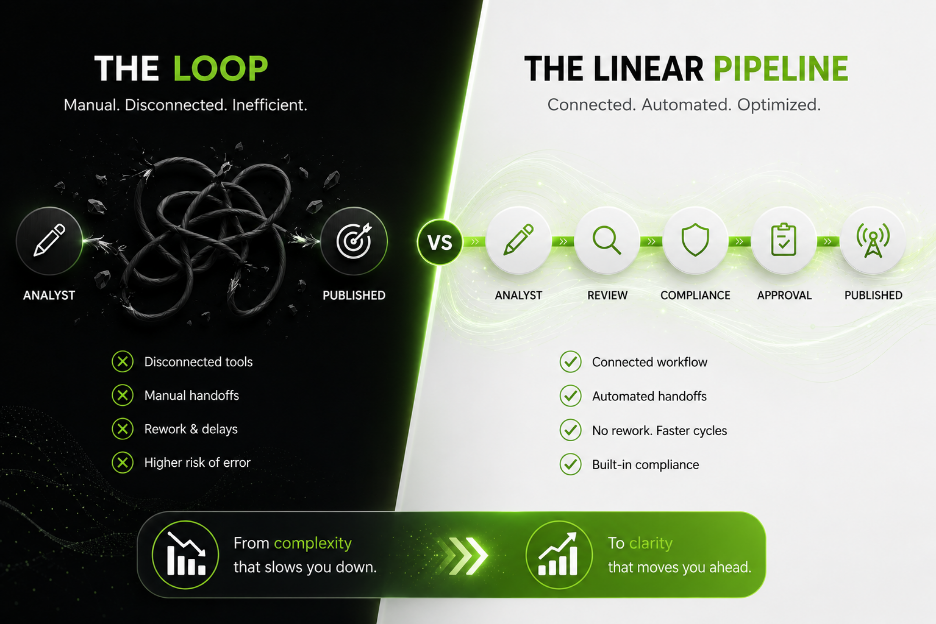
A research desk can lose a surprising amount of time to work that is technically “finished” but not yet publishable.
A valuation changes after a note enters review. Compliance flags a disclosure late in the process. Two reviewers comment on different files. An analyst makes another round of edits simply to reconcile versions before publication.
None of these issues says anything about the quality of the investment thesis. Yet each one affects the quality, timeliness and reliability of the final research output.
For research leaders, the challenge is therefore not just to publish faster. It is to reduce unnecessary rework while maintaining the supervisory, compliance and publishing controls expected in capital markets.
Analytical quality and process quality are different disciplines
Strong equity research depends on both.
Analytical quality comes from the research analyst: the assumptions, forecasts, valuation methodology, industry knowledge and investment judgment behind the recommendation.
Process quality determines whether that analysis reaches clients in the correct form, using the right data, version, approvals and disclosures.
A research view can be analytically sound and still be weakened by the production process. A stale forecast, inconsistent chart, incorrect disclosure or outdated document version can undermine an otherwise strong note.
That is why report quality cannot be assessed only at the level of investment insight. It also depends on how the note moves from analysis to publication.
Research notes usually break at the handoffs
The most fragile points in the equity research process are often the transitions between people, files and systems.
A typical workflow creates several control points
An analyst may:
- update the financial model;
- draft the research note;
- send it for supervisory review;
- incorporate changes;
- move it through compliance;
- prepare the final version;
- release it for distribution.
Each stage is reasonable on its own. The problem appears when the connections between them rely on manual intervention.
Common examples include:
- a reviewer working from an older version;
- financial assumptions changing after review has started;
- unclear ownership of the next approval;
- repeated edits with limited traceability;
- compliance issues appearing late in the process;
- publication depending on someone manually confirming the final file.
Experienced teams often compensate for these weaknesses through email, local folders and personal follow-up. That keeps the process moving, but it also hides how much senior time is being spent managing workflow rather than producing research.
Earnings season makes weak workflow more expensive
Earnings season puts these issues under pressure.
Research analysts are updating models, listening to calls, speaking to management teams and publishing into a market where timing matters. Supervisory analysts and compliance teams are reviewing multiple notes at the same time.
A small process failure can therefore create a larger rework cycle.
For example, if a forecast changes after a note has already entered review, the impact may extend beyond one edit. The note may need to return to the analyst, move back through review and undergo another compliance check before it can be released.
The cost builds across several roles.
This is where workflow quality becomes an economic issue rather than an administrative one.
Rework has a cost, even when it is not measured
Most research organizations can see direct costs such as headcount, data services and technology spend. Rework is less visible.
The desk rarely records the cumulative hours spent reopening completed notes, repeating supervisory checks, reconciling files or resolving late-stage compliance issues.
Yet that time has an opportunity cost.
What rework displaces
Every avoidable rework cycle takes capacity away from activities that matter more to the research franchise, including:
- deeper company and sector analysis;
- client conversations;
- differentiated idea generation;
- management access;
- thematic research;
- faster reaction to market events.
The objective of workflow control should therefore be to reduce unnecessary touches without weakening governance.
That is a more demanding standard than simple workflow automation. Moving a note faster through a generic approval chain is useful, but it does not address the deeper problem if authoring, financial data, compliance and distribution still sit in separate processes.
Control works best inside the research production environment
Research workflow controls are more effective when they operate close to the work analysts already perform.
ANALEC Resonate connects research authoring, workflow approval, compliance and distribution within the wider production process.
Authoring stays close to the analyst
Resonate supports research authoring within Microsoft Office, reducing the need for analysts to leave familiar working environments purely to satisfy process requirements.
This matters because adoption is often where workflow programmes fail. If controls create significant extra work, teams naturally find ways around them.
Approval paths can reflect the research product
Different document templates can follow different approval paths. Approval activity can be date- and time-stamped, turnaround time can be captured, and a note can be demoted to an earlier participant when rework is required.
That gives research management clearer visibility into where time is being lost and where notes repeatedly move backwards.
Financial data remains connected to production
Resonate also uses a centralised market data feed to drive valuations.
That is important because many research quality problems begin before review. If a valuation in the note no longer reflects the underlying financial data, the workflow is already carrying a problem downstream.
Keeping data and publishing processes closer together reduces the number of manual reconciliation points.
Compliance sits within the same flow
Document Sweep and OCR capabilities support compliance checks against the note itself. Disclaimers and disclosures can also be applied conditionally according to the content and relevant jurisdiction.
This moves compliance closer to production rather than treating it as a final gate at the end of the process.
Final approval connects directly to distribution
Once a note reaches final approval, distribution can follow saved client preferences. Research can also be contributed to third-party aggregators using RIXML.
Readership data then provides visibility into how the published research is being consumed.
The result is a more connected research lifecycle: author, review, control, release and measure, without introducing unnecessary breaks between each stage.
Research teams should fix the highest-cost friction first
Improving the research workflow does not require redesigning everything at once.
A better starting point is to identify where completed work repeatedly moves backwards.
Research leaders should examine:
- where multiple versions typically appear;
- which approval stages create recurring delays;
- where financial data needs manual reconciliation;
- which compliance issues are detected late;
- where publication still depends on manual handoffs;
- which notes require the most repeated review effort.
From there, workflow controls can be applied to the points that create the greatest cost or risk.
The goal is not more process. It is a more controlled production environment in which fewer people have to touch the same work twice.
For research organizations, that is the practical connection between workflow control and report quality. Better analysis remains the foundation of equity research. But a stronger process determines how efficiently, consistently and reliably that analysis reaches the market.
FAQs:
1. What are workflow controls in equity research?
Workflow controls are the structured steps, approvals and checks that govern how a research note moves from drafting to publication. They can include defined approval paths, version management, compliance checks, audit trails and controlled distribution. Their purpose is to reduce avoidable errors and create greater consistency across the research production process.
2. How can workflow controls improve equity research report quality?
Workflow controls improve report quality by reducing operational problems that can weaken otherwise strong analysis. Clear review stages, better traceability and stronger control over financial data and document versions can help prevent stale numbers, conflicting files, missed checks and repeated revisions from reaching the final publication.
3. Why is rework a significant issue for equity research teams?
Rework consumes analyst, supervisory and compliance capacity without creating new research value. A note returned because of an outdated valuation, disclosure issue or version conflict may have to pass through several stages again. During busy periods such as earnings season, repeated rework can materially increase the cost and time required to publish research.
4. How does ANALEC Resonate support research workflow management?
ANALEC Resonate connects research authoring, workflow approval, compliance and distribution within the research production process. It supports Microsoft Office-based authoring, configurable approval paths, date- and time-stamped workflow activity, rework through document demotion, centralised valuation inputs, Document Sweep and OCR-supported compliance checks, and controlled research distribution.
5. What should research teams improve first in their publishing workflow?
Research teams should begin with the areas where completed work most often moves backwards. Common priorities include recurring version conflicts, late compliance issues, manual financial-data reconciliation, approval bottlenecks and disconnected publishing steps. Addressing these high-cost friction points first can improve workflow control without adding unnecessary process.