
How OCR Helps Improve the Accuracy of Investment Research Compliance Reviews
Every hour a compliance reviewer spends searching a research note for information that should be easy to locate adds cost to publication without adding investment insight. The tension is familiar across equity research: review too slowly and a note loses relevance as markets move; review too quickly and the firm risks an incomplete compliance assessment; grow volumes without better process support and the choice becomes more headcount, slower publication, or greater operational risk.
The problem becomes more acute as research content grows more complex. A single equity research note may combine written analysis, financial tables, charts, valuation outputs, disclosures, and material imported from other documents. Compliance is therefore reviewing more than prose. It is reviewing a publishing product assembled from multiple information formats.
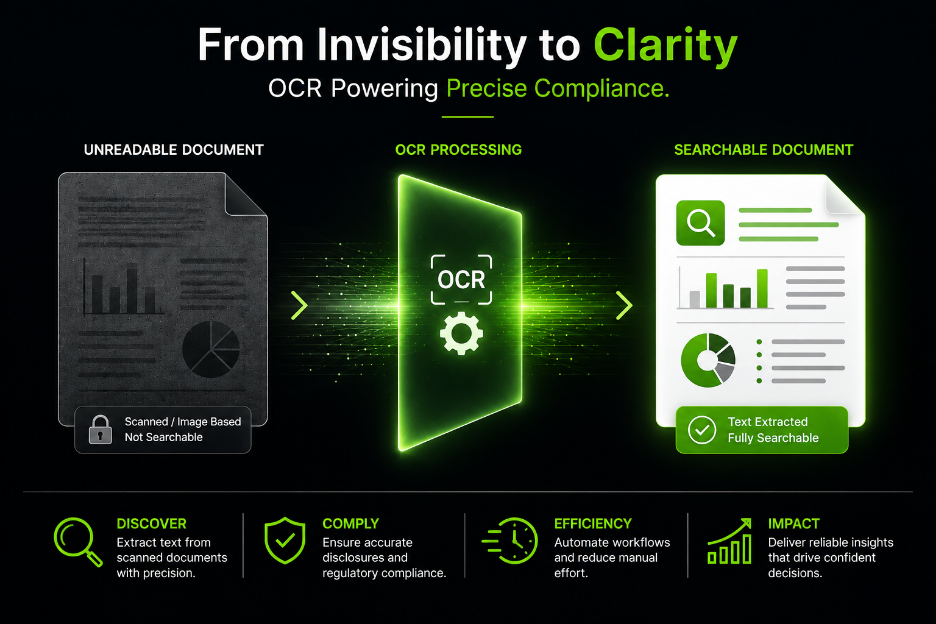
Optical Character Recognition, or OCR, addresses one part of this problem. It converts text that would otherwise be difficult for software to read such as text contained in scanned documents or image-based files into machine-readable information. In an investment research compliance process, that creates a broader and more consistent information base for downstream checks.
The value of OCR is specific: it reduces the amount of document content that remains effectively invisible to systematic review.
OCR Makes Image-Based Content Visible to Compliance Checks
Conventional text search works well when information already exists as searchable text. Research publishing is rarely that tidy.
Analysts may work with:
- PDFs
- Scanned documents
- Screenshots
- Embedded charts
A reviewer can inspect those materials manually, but the process depends heavily on visual examination and individual attention. OCR changes the accessibility of that content by recognizing text within non-searchable source material and converting it into machine-readable characters, allowing that information to be searched, identified, and processed by downstream review tools.
For investment research compliance, a control is only as useful as the information available to it. A rules engine or document check cannot evaluate text it cannot see. OCR therefore operates upstream of the compliance decision:
- The research document enters the workflow.
- OCR makes otherwise inaccessible text machine-readable.
- Extracted information becomes available for search and identification.
- Compliance rules and review logic are applied.
- A reviewer evaluates issues that require judgment.
OCR supports the reviewer; it does not replace the reviewer.
What Manual Review Misses as Volumes and Formats Multiply
Manual review works reasonably well when research volumes are low, documents are standardized, and reviewers have enough time. Those conditions become harder to maintain in an active research house publishing across companies, sectors, products, and markets.
The weak point is not usually a lack of expertise. It is attention at scale.
A compliance professional may be reviewing several notes while also checking disclosures, issuer references, analyst certifications, restricted-list considerations, and other internal requirements. When part of that work involves repeatedly searching pages or visually inspecting non-searchable content, the review process accumulates friction.
As publication volumes rise and document formats multiply, reviewer capacity gets consumed by repetitive checks and information becomes harder to locate consistently. Under time pressure, search effort competes directly with judgment and when reviewers approach documents differently across disconnected processes, both consistency and auditability weaken.
There is also an operational issue: a research house cannot scale a control framework indefinitely by adding more manual checking. Growing note volumes eventually force a choice between more headcount, slower publication, or better technology support. OCR changes that equation by improving the accessibility of the underlying document. It does not remove the review burden, but it removes part of the search burden.
Accuracy First, Efficiency as the Consequence
The strongest case for OCR in investment research compliance is accuracy, not speed.
If more of a research note can be converted into searchable, machine-readable text, compliance checks operate against a more complete representation of the document. Relevant words, phrases, and other textual information become easier to locate consistently rather than depending entirely on a reviewer scanning every page.
What Improves When Content Becomes Searchable
When content becomes searchable, compliance teams:
- Locate relevant information faster.
- Apply document checks more consistently.
- Reduce repetitive page-by-page searching.
- Work with a more complete body of searchable content.
- Direct more attention toward interpretation and judgment.
- Handle growing research volumes with greater process discipline.
A reviewer who spends less time hunting through a document can spend more time assessing the issues that require interpretation. Compliance productivity means directing scarce reviewer attention toward the decisions where judgment matters most, not processing more notes per hour.
OCR Still Has Practical Limits
OCR quality depends on the quality and structure of the source document. Firms should consider:
- Scan quality
- Document layout
- Complex tables
- Unusual fonts
- Image resolution
- Validation requirements
- Data security
- Integration with publishing workflows
- Auditability of downstream actions
No OCR engine independently guarantees regulatory compliance, prevents every error, or removes the need for human review.
OCR Only Creates Control Inside a Governed Workflow
OCR by itself is a document-processing capability. It becomes a compliance control only when it sits inside a governed investment research workflow.
A document enters the process. OCR makes previously inaccessible text machine-readable. The extracted content becomes available for search and identification. Relevant compliance rules and review logic are applied. A human reviewer validates issues that require judgment. The resulting approval activity is captured as part of the audit trail.
A Governed Review Process
This is materially different from simply giving compliance a searchable PDF. A strong workflow connects document visibility with process discipline. It defines:
- Who reviews a note
- Which approval stages apply
- What happens when rework is required
- How changes move through the process
- Which actions are recorded
- How the firm demonstrates that review occurred
ANALEC Resonate supports customizable research approval workflows, date- and time-stamped workflow activity, compliance controls, and audit trails around the research publication process.
That broader governance is what turns OCR from a convenience into a control.
Where Document Sweep and OCR Sit Within ANALEC Resonate
ANALEC Resonate brings research authoring, workflow approval, compliance controls, and content distribution into the same investment research operating environment. Within that framework, its Document Sweep and OCR capability enhances the accuracy of compliance checks.
The significance is architectural rather than cosmetic. OCR sits before the compliance decision, improving the document information available to the review process. Workflow controls then govern how the note moves through approval, while audit functionality records actions taken during that journey. Resonate also supports disclaimer and disclosure management within research workflows.
For research organizations, this creates a more coherent control model: analysts continue producing investment research, compliance works with a more accessible document, and approval remains governed rather than reduced to a standalone document scan.
The Strategic Value for Research Houses
For Heads of Research and compliance leaders, the issue is ultimately one of operating leverage.
As research volumes grow, firms need to avoid a model in which every incremental increase in publication activity creates a matching increase in manual review effort.
That is where OCR becomes commercially relevant. Its role is not to replace compliance expertise, but to ensure that expertise is used on interpretation, exceptions, and judgment rather than repetitive document discovery.
OCR will not remove the need for experienced compliance professionals. Nor should it. Its role is to make underlying research content easier to inspect systematically so human judgment is applied where it has the greatest value.
For firms reassessing the cost, consistency, and control of investment research compliance reviews, that is the more useful way to think about OCR: not as automation replacing oversight, but as infrastructure that makes better oversight possible.
Organizations looking to strengthen that operating model can explore how ANALEC Resonate combines Document Sweep and OCR with broader research approval, compliance, disclosure, and audit controls.
FAQs:
1. How does OCR improve investment research compliance reviews?
OCR converts text in scanned or otherwise non-searchable content into machine-readable information. This gives compliance teams a more complete body of searchable content and reduces reliance on page-by-page visual inspection during research note reviews.
2. Can OCR replace human compliance reviewers?
No. OCR supports the reviewer; it does not replace the reviewer. Its role is to make information easier to identify and process, while compliance rules, review logic, escalation decisions, and regulatory judgment still require appropriate human oversight.
3. Why is OCR useful in equity research workflows?
Equity research notes often contain a mix of native text, PDFs, screenshots, scanned documents, and embedded charts. OCR improves the accessibility of content that may otherwise be difficult to search, helping compliance teams locate relevant information more consistently before publication.
4. What are the limitations of using OCR for research compliance?
OCR accuracy depends on factors such as scan quality, document layout, image resolution, fonts, and complex tables. It should therefore operate within a governed compliance workflow that includes validation, appropriate controls, and an auditable approval process.
5. How does ANALEC Resonate use OCR within investment research workflows?
ANALEC Resonate combines Document Sweep and OCR with broader research workflow and compliance controls. Its Document Sweep and OCR capability enhances the accuracy of compliance checks, while customizable approval workflows, date- and time-stamped activity, audit trails, and disclaimer and disclosure management provide the governance around the review process.