
LLMs, RAG, and Research Automation: What Capital Markets Teams Need to Understand
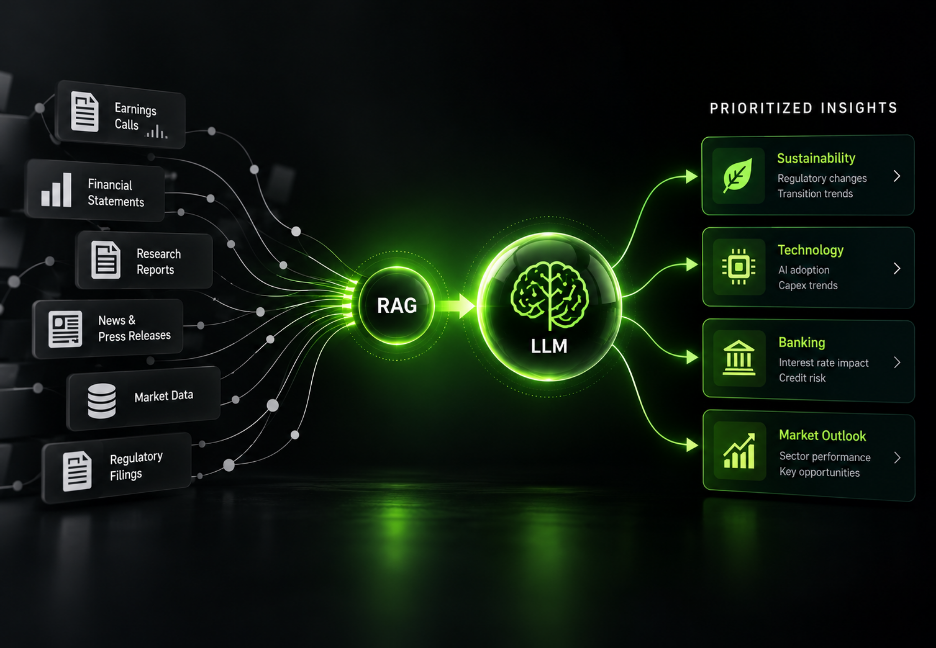
Equity research teams rarely struggle with a shortage of information. The bigger challenge is finding what matters, understanding its relevance, and acting on it before the opportunity passes.
Analyst reports, earnings transcripts, financial statements, market developments, and client requests generate enormous volumes of information. Much of it sits across disconnected systems, making research discovery and analysis unnecessarily time-consuming.
Large Language Models (LLMs), Retrieval-Augmented Generation (RAG), and research automation offer a way forward. But an LLM alone cannot deliver dependable financial research intelligence. The real opportunity lies in combining AI with trusted information, relevant context, and intelligent research workflows.
What Are LLMs and Why Do They Matter for Capital Markets?
Large Language Models (LLMs) are AI systems trained to understand and generate human language. They identify patterns in information and produce responses to questions or instructions.
For equity research analysts, this creates practical opportunities. LLMs can help summarize earnings calls, extract information from annual reports, compare management commentary, and identify recurring themes across financial documents.
Consider an analyst reviewing several quarters of company earnings commentary. Instead of manually searching multiple transcripts, an LLM can help identify discussions around margin pressures, capital expenditure, or management guidance.
However, an LLM can produce a convincing answer without producing a correct one. In investment research, where historical context, financial accuracy, and source reliability matter, that distinction is critical.
What Is RAG and How Does It Make AI More Useful for Financial Research?
Retrieval-Augmented Generation (RAG) is an approach that allows AI to retrieve relevant information from selected knowledge sources before generating a response.
Think of it as giving an AI assistant access to a research library rather than asking it to answer entirely from memory.
The process follows three steps:
Retrieve → Contextualize → Generate
- Retrieve: Find relevant analyst reports, financial documents, or company information.
- Contextualize: Provide that information to the LLM alongside the user's question.
- Generate: Produce an answer informed by the retrieved material.
For example, an equity sales professional might ask: How has our research team's outlook on a particular banking stock changed over the last four quarters?
A RAG-based system connected to an authorized research archive could retrieve earlier publications, compare valuation assumptions, identify revisions to earnings expectations, and summarize how the investment thesis evolved.
This makes RAG in finance valuable not simply for finding documents, but for making accumulated research knowledge more accessible.
Why Is RAG Important for Unlocking Institutional Research Intelligence?
Research houses accumulate considerable intellectual property through years of company coverage, financial modelling, earnings analysis, and investment recommendations. Yet much of that knowledge remains embedded in historical publications and fragmented repositories.
Finding an earlier report is relatively straightforward. Understanding how an analyst's assumptions changed across multiple reporting periods is considerably harder.
RAG-based approaches can help connect historical research insights with current questions, allowing teams to examine previous investment theses, valuation changes, and the reasoning behind earlier forecasts.
For research management, this creates an opportunity to preserve institutional memory and derive greater value from existing research IP, particularly when analyst coverage responsibilities change.
However, retrieval quality depends on the underlying data. Outdated research, inconsistent classifications, incomplete archives, and access restrictions can limit reliability. RAG does not eliminate inaccurate AI-generated responses; source validation and appropriate controls remain essential.
What Can Research Automation Actually Automate?
Research automation uses technology to reduce repetitive activities involved in discovering, processing, preparing, and distributing financial research.
Potential applications include:
- Research discovery: Finding relevant publications across research repositories.
- Information extraction: Identifying financial figures, management commentary, and important developments.
- Document summarization: Creating concise briefings from lengthy reports or transcripts.
- Thematic analysis: Identifying recurring topics across companies, sectors, or publications.
- Research monitoring: Tracking new publications and surfacing potentially relevant insights.
- Publication workflows: Supporting document preparation, approval, compliance checks, and distribution.
Equity research automation is particularly valuable when repetitive administrative work consumes time better spent evaluating companies and investment opportunities.
The objective is not to automate investment judgment. It is to reduce the effort required to support it.
How Do LLMs, RAG, and Research Automation Work Together?
These technologies address different parts of the research intelligence process.
Together, they can support a workflow in which relevant company information is retrieved, interpreted for analyst review, and incorporated into controlled research production processes.
Importantly, generating research content and approving it for publication remain separate responsibilities.
How Can AI-Powered Research Benefit Capital Markets Participants?
The value of AI in capital markets varies across the research and client-engagement ecosystem.
Research houses can make historical research IP more accessible, preserve institutional knowledge, and improve the utility of accumulated research.
Equity research analysts can spend less time gathering information and more time evaluating financial performance, valuation assumptions, and investment implications.
Equity sales and trading teams can identify relevant research themes and changes in analyst views, supporting more informed client conversations.
Buy-side clients can navigate substantial volumes of investment research more efficiently, helping them find information relevant to their investment process.
Corporate and issuer clients can benefit from more informed discussions around company developments, research coverage, and market perceptions, subject to appropriate information access.
How Does Analec Resonate Support AI-Assisted Research Workflows?
Analec Resonate addresses several operational challenges involved in producing, managing, and distributing institutional investment research.
Its capabilities span research authoring, workflow approvals, compliance controls, digital distribution, and readership analytics. These functions help research organizations manage the research lifecycle while maintaining consistency and oversight.
ANALEC's GenAI-assisted research capabilities also include prompt-based assistance, predefined and user-created prompt libraries, and the ability to incorporate AI-generated content into research notes. Timestamping and audit trails support accountability when such content enters the research process.
This matters because AI-generated research assistance must operate within established editorial, compliance, and publication controls rather than outside them.
Resonate's broader research management and engagement analytics capabilities position it within the evolution toward more connected research intelligence. They provide an operational foundation for research automation without implying that every AI or RAG application is already embedded within the platform.
Why Do Human Judgment and Research Governance Still Matter?
AI-assisted research does not remove the responsibility of analysts, research supervisors, or compliance teams.
Financial assumptions must be challenged, source information verified, and investment conclusions assessed against market developments and company-specific risks. AI-generated content also requires appropriate oversight before entering published research.
For research houses, that means maintaining clear approval responsibilities, disclosure controls, auditability, and appropriate restrictions on sensitive information.
The strongest model combines human financial expertise with intelligent technology operating inside well-governed research workflows.
What Should Capital Markets Teams Take Away From AI in Research?
The strategic value of LLMs in capital markets depends less on how much content they generate and more on how effectively organizations connect AI with reliable information, historical research knowledge, and established workflows.
LLMs help interpret information. RAG makes relevant institutional knowledge more accessible. Research automation reduces repetitive work while supporting more efficient research production and delivery.
Platforms such as Analec Resonate contribute to this evolution through research authoring, GenAI-assisted workflows, compliance oversight, distribution, and engagement analytics.
Ultimately, the opportunity is not simply to produce more research. It is to find the right information, understand it in context, preserve institutional knowledge, and turn research intelligence into useful action.
FAQs
1. How are LLMs used in equity research and capital markets?
Large Language Models (LLMs) help equity research analysts and capital markets professionals process large volumes of financial information. They can summarize earnings transcripts, analyze financial documents, compare management commentary, and identify research themes. However, AI-generated outputs require verification, as financial accuracy, source reliability, and market context remain essential to investment research.
2. What is the difference between LLMs and RAG in financial research?
LLMs generate responses using patterns learned during training and information provided in a prompt, while Retrieval-Augmented Generation (RAG) retrieves relevant information from selected sources before generating an answer. In financial research, RAG can help connect AI-generated responses to analyst reports, historical financial data, valuation assumptions, and research archives, making the responses more contextually relevant and easier to verify.
3. How can RAG help research houses make better use of historical investment research?
RAG can help research houses access and interpret institutional knowledge accumulated across years of analyst coverage. By retrieving relevant historical reports, investment theses, earnings forecasts, and valuation changes, RAG-based systems can support comparisons between past and current research views. This helps organizations derive greater value from existing research intellectual property and preserve institutional memory when analyst coverage responsibilities change.
4. Can AI-powered research automation replace equity research analysts?
AI-powered research automation is designed to support analysts rather than replace their professional judgment. It can reduce repetitive activities such as information gathering, document summarization, research discovery, and report preparation. However, evaluating financial assumptions, interpreting market developments, validating sources, and making investment recommendations still require human expertise, critical thinking, and appropriate compliance oversight.
5. How does Analec Resonate support AI-assisted investment research and research automation?
Analec Resonate supports institutional research workflows through research authoring, publication approvals, compliance controls, content distribution, and readership analytics. Its GenAI-assisted capabilities include prompt-based research assistance, customizable prompt libraries, and timestamping and audit trails for AI-generated content used in research notes. These capabilities help research organizations introduce AI assistance while maintaining oversight, accountability, and established publication controls.