
Beyond the PDF: Why the Research Email Still Matters in Institutional Client Engagement
Institutional research is expensive before distribution even begins.
Analyst time has been committed. Financial models have been updated. Supervisory review has taken place. Compliance checks and disclosures have been completed. By the time an equity research note is approved for publication, most of the production cost is already fixed.
What happens next determines whether that investment generates readership.
The PDF remains an important research format, but it does not tell the research provider who actually engaged with it. A portal requires the client to visit. An aggregator inserts another platform between the research provider and the consumption record. A PDF sent or downloaded in isolation provides very little client-level visibility.
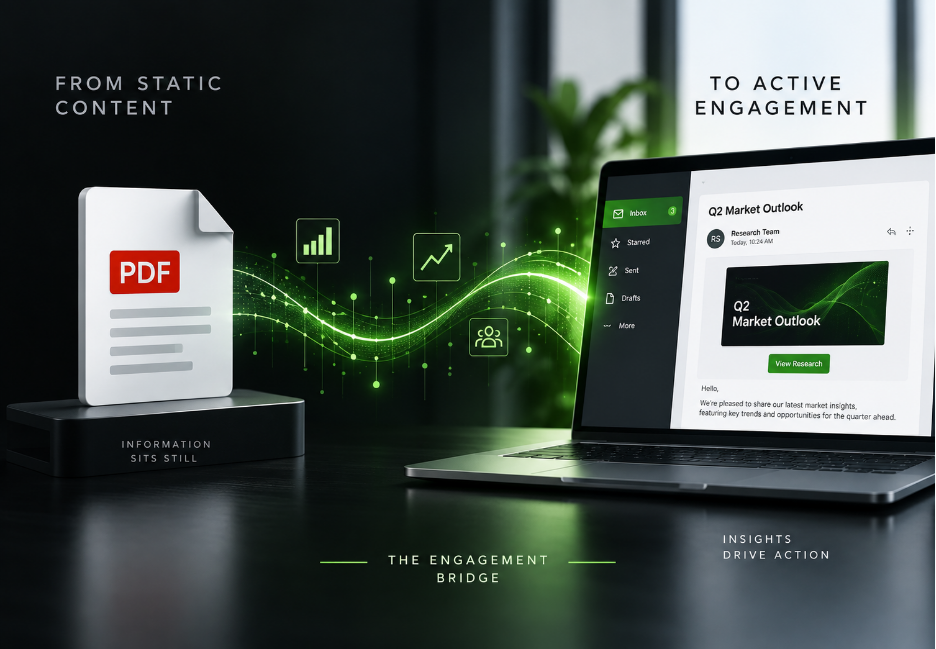
Email is different. In the normal outbound research workflow, distribution and measurement happen through the same event: a named recipient receives the research, and subsequent engagement with that delivery can be tracked. That makes the research email an important engagement layer around the underlying content.
Email is the only research channel where distribution and measurement are the same event
Research email combines delivery with a direct recipient record.
When a research team publishes through a portal, the client must come to the research provider. When research reaches the market through an aggregator, readership sits partly within a third-party environment. When a PDF is simply circulated, the file itself says nothing about who opened the message, followed the link or returned to the research.
Email closes that gap.
A research email identifies the recipient at the point of distribution and creates a measurable digital interaction around the note. The email establishes the research franchise, surfaces the investment message and directs the recipient to the full research in the appropriate format.
This is the practical distinction between delivering research and knowing whether somebody engaged with the delivery.
For a Head of Research or Research COO, that distinction has economic value. The cost of producing the note does not change because ten clients read it rather than one. What changes is the organization’s visibility into what that fixed production cost actually generated.
Relevance, not branding, determines whether a research email gets opened
Branding matters, particularly in crowded institutional inboxes. But branding without relevance is merely presentation.
The harder question is whether the recipient should have received that research in the first place.
Institutional research preferences differ by issuer, sector, geography, analyst, research product and investment theme. Delivery preferences differ as well. A client following European banks does not need every publication produced by the research franchise simply because the email template is polished.
Preference-led distribution therefore matters more than broad circulation. The research email becomes more useful when the recipient list reflects known interests rather than the widest available mailing universe.
For Research and institutional sales teams, this is where distribution discipline starts to matter. More sends do not necessarily create more value. Better relevance creates a stronger basis for meaningful readership.
Layout should follow research product type
A morning note, earnings flash and thematic research piece are consumed differently, and the email should reflect that.
A morning note needs to communicate quickly. An earnings flash may need to surface the change in estimates, recommendation or investment view immediately. A thematic publication has more room to frame the argument and draw the client into deeper reading.
Using one email treatment for every research product ignores those differences.
The institutional identity should remain consistent, but the hierarchy and presentation of information in the inbox should follow the job the research product is intended to do. For fast-turnaround research, the email may carry much of the immediate context. For deeper research, its role is to establish relevance and create a clear route into the full note.
The email is therefore part of research product design, not simply a delivery envelope added after publication.
Useful email metrics stop at the account, not the click
The most useful research email metrics are those that help the organization understand recipient and account-level consumption.
That includes opens, click-through behaviour, repeat engagement, format preference and patterns of readership across recipients within an institution.
The important unit is not the isolated click. It is the account context around it.
If several recipients at one institution repeatedly engage with research on a particular sector or product, that is more informative than a single click viewed on its own. Equally, repeated engagement from one portfolio manager may warrant attention even when the broader account appears less active.
These signals still require discipline. Open measurement itself is not always perfect, and a click does not prove investment intent, commercial value or broker-vote attribution. Consumption data sits alongside calls, meetings and account knowledge. It does not substitute for them.
Its value is narrower and more practical: it gives Research and Sales evidence about what appears to be getting read.
Resonate distributes against stored client preferences and returns consumption data to the client record
ANALEC Resonate connects research distribution with measurable readership.
Resonate delivers branded, responsive research email templates and applies different layouts to different research product types. It distributes research against stored client preferences, so outbound research reflects recipient interests rather than a static broadcast list.
It also tracks research consumption at recipient and institution level and returns engagement information through CRM integration, so readership becomes part of the client record rather than remaining isolated inside the publishing workflow.
The note's cost is fixed before the email goes out
The economics of research are largely determined before the email is sent. Analyst time, review, compliance and publishing effort are already spent.
The email provides one of the lowest-friction ways to find out what that expenditure produced.
A research note may have reached one active account or forty. Without a measurable engagement layer, the provider may know that the research was published and distributed but very little about what happened next.
The PDF still carries the research. The email tells the research organization whether the intended client encountered it, engaged with it and gave the firm a usable signal in return.
FAQs
1. Why is email still important for institutional research distribution?
Email remains important because it combines distribution with a named recipient record. Unlike a portal, which requires the client to visit, or a PDF viewed in isolation, a research email gives the provider a measurable interaction around the delivery itself. That makes email useful for understanding whether research reached and engaged the intended institutional audience.
2. Is email replacing PDFs or research portals?
No. PDFs remain an important format for equity research, while portals and third-party platforms continue to play a major role in distribution. Email works alongside these channels by providing context, directing recipients to the research and creating a measurable engagement event around the underlying content.
3. How does client preference data improve research email engagement?
Client preference data helps research teams send more relevant content based on factors such as issuer, sector, geography, analyst, research product or delivery format. This reduces indiscriminate distribution and gives institutional clients a better chance of receiving research that matches their interests.
4. What research email metrics are most useful?
Useful metrics include opens, click-through behaviour, repeat engagement, format preference and readership patterns across recipients within an institution. These signals should be interpreted at account level rather than treated as isolated clicks, and they do not by themselves prove investment intent, commercial value or broker-vote attribution.
5. How does ANALEC Resonate support measurable research email distribution?
ANALEC Resonate connects research distribution with measurable readership by delivering branded, responsive email templates, applying layouts by research product type, distributing against stored client preferences and tracking consumption at recipient and institution level. Engagement information can also be returned through CRM integration so readership becomes part of the broader client record.