
The Hidden Hours: Where Does a Sell-Side Equity Research Analyst's Week Actually Go?
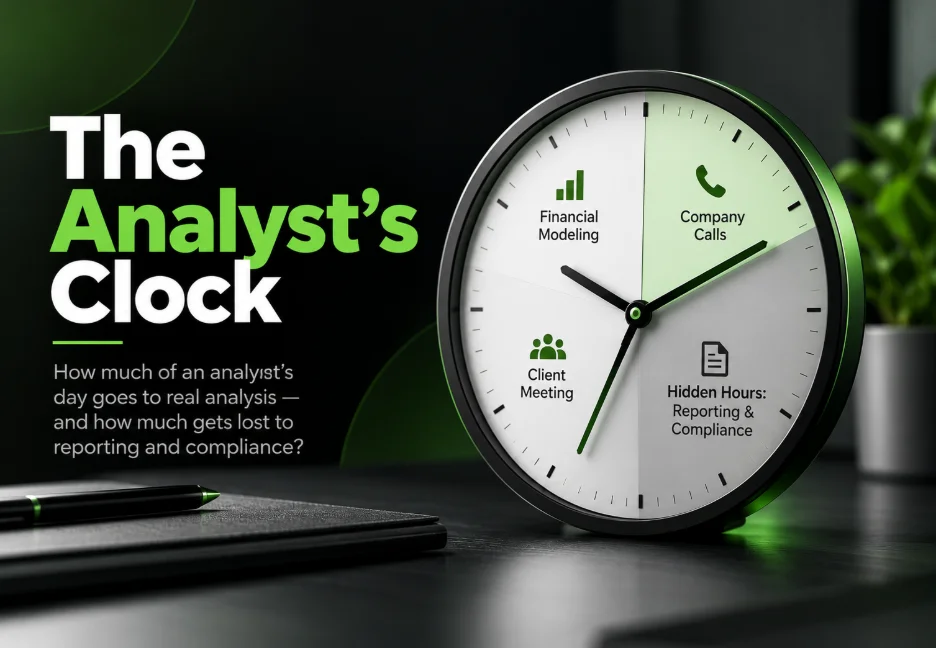
An equity research analyst updates earnings forecasts, revises a valuation, and reaches an investment conclusion. But the work is far from finished.
Additional effort goes into turning those findings into a publication-ready report: updating tables, checking figures, reviewing disclosures, securing approvals, and coordinating distribution.
In sell-side equity research, these activities are essential to delivering accurate, timely investment insights. The challenge is distinguishing necessary research and regulatory work from repetitive tasks that consume valuable analytical time.
Understanding where those hidden hours accumulate can help research houses improve productivity without compromising research quality.
What Does a Typical Week in Sell-Side Equity Research Actually Look Like?
A sell-side equity research analyst's week moves between financial analysis, company monitoring, report preparation, and client engagement. Planned responsibilities frequently overlap with unexpected market developments.
Consider this illustrative week for an analyst covering several listed companies:
This is not a fixed industry schedule. Earnings season, company announcements, and market volatility can compress several activities into a single day.
The important distinction is between time spent producing investment insights and time spent preparing, reviewing, and delivering them.
Which Hidden Tasks Consume Time in an Equity Research Analyst's Week?
Several recurring sources of avoidable effort sit between analysis and publication.
Consider an analyst revising earnings estimates after a company's quarterly results.
The revised assumptions must be validated and reflected in the financial model. Corresponding figures may then need updating in valuation tables, earnings commentary, charts, and the report summary.
Checking those figures is essential. Manually transferring the same approved information across disconnected documents creates unnecessary repetition.
Other sources of hidden work include:
- Searching previous reports for historical assumptions and commentary.
- Reformatting recurring research tables and charts.
- Tracking document revisions across multiple reviewers.
- Recreating research summaries from already published material.
- Responding to repeated information requests from equity sales teams.
Individually, these tasks may appear manageable. Across multiple companies and publication deadlines, they can place considerable pressure on an analyst's working week.
How Do Manual Research Workflows Affect Productivity and Client Service?
Fragmented equity research workflows can create additional rework, publication delays, and information-control challenges.
During earnings season, analysts may need to update several reports while responding to institutional investors seeking immediate clarification.
A particular concern is maintaining a clear distinction between draft estimates and approved or published financial information. Weak version controls can increase reconciliation effort and the risk of inconsistent figures appearing in research outputs.
Publication delays create another challenge. A report may be analytically complete but remain awaiting review, compliance clearance, or distribution.
For equity sales and trading professionals, delayed availability can reduce the time available to discuss research with buy-side clients.
However, publication turnaround and analyst productivity are different measures. Reducing approval waiting time does not necessarily mean an equivalent reduction in analysts' working hours.
How Can Equity Research Teams Save Time Without Compromising Research Quality?
Research teams can improve analyst workflow efficiency by reducing unnecessary repetition while preserving financial validation, research independence, and compliance controls.
Practical priorities include:
- Standardize reporting: Use consistent templates for recurring research publications.
- Control financial data: Maintain clear distinctions between draft, approved, and published estimates.
- Organize historical research: Make previous publications and assumptions easier to retrieve.
- Reduce duplicate handling: Avoid manually transferring identical information between systems.
- Clarify approvals: Establish visible ownership and defined review responsibilities.
Previously published commentary can support future work, but its assumptions, relevance, and disclosures must be reassessed before reuse.
Equity research technology should support professional judgment rather than replace it.
How Does ANALEC Resonate Help Address the Hidden Work Behind Equity Research?
ANALEC Resonate is an investment research authoring, workflow, and distribution platform designed to support the research publication lifecycle.
Its documented capabilities address several sources of operational effort.
A connected equity research workflow can look like this:
Update estimates → Populate report templates → Complete review and approval → Distribute published research → Assess readership engagement
Resonate supports these stages through:
- Centralized financial data and Microsoft Office-based authoring: Helps populate research templates and reduce repeated data entry and formatting.
- Configurable workflow approvals and audit trails: Provides visibility into document status, reviewer responsibilities, and compliance processes.
- Content reuse and report compilation: Supports creating summaries and recurring publications from relevant existing research content.
- Preference-based distribution: Helps deliver approved research to appropriate institutional recipients and third-party aggregators.
- Readership analytics: Provides engagement signals that can inform research distribution and sales follow-up.
These capabilities address work surrounding the investment decision. They do not establish whether an analyst's forecasts are correct or whether readership translates into investment activity.
How Can Research Houses Identify Their Biggest Workflow Bottlenecks?
Research houses can begin with a simple workflow assessment rather than assuming every manual task requires automation.
Review a small sample of recently published earnings updates and ask:
Separating preparation effort, avoidable rework, and approval waiting time helps management identify where changes could deliver practical value.
When evaluating equity research software, firms should also consider existing-system integration, access controls, implementation effort, scalability, and analyst adoption.
Can Better Research Workflows Help Analysts Focus on What Matters Most?
Better equity research workflows can create more capacity for thoughtful analysis and responsive client engagement.
An analyst's contribution is not measured by the number of documents formatted or spreadsheets repeatedly updated. It is measured by the quality, relevance, and timeliness of the investment insights delivered.
For research houses, addressing hidden operational effort means protecting the time analysts need to produce differentiated research.
Explore ANALEC Resonate to discover how connected authoring, workflow controls, and research distribution can support a more productive research organization. Contact our team to request a demo.
FAQs
1. What does a sell-side equity research analyst do in a typical week?
A sell-side equity research analyst spends their week monitoring markets, reviewing company financials, updating earnings forecasts, preparing research reports, and engaging with institutional clients. Alongside financial analysis, analysts manage report formatting, compliance reviews, publication approvals, and internal coordination. The balance of these activities varies depending on earnings announcements, market conditions, and company coverage responsibilities.
2. What are the biggest time-consuming challenges in sell-side equity research?
Some of the biggest workflow challenges include repetitive data entry, updating financial models and research documents, retrieving historical information, formatting reports, and coordinating publication approvals. These activities are necessary to varying degrees, but disconnected systems and manual processes can create avoidable duplication. During earnings season, these inefficiencies can increase pressure on analysts and delay research delivery.
3. How can equity research analysts improve productivity without compromising research quality?
Equity research analysts can improve productivity by standardizing report templates, centralizing financial estimates, organizing historical research, and reducing repetitive administrative tasks. Clear approval workflows and better coordination between research and compliance teams can also reduce unnecessary rework. The objective is to automate routine processes while preserving financial accuracy, independent analysis, and regulatory oversight.
4. How does ANALEC Resonate help improve equity research workflows?
ANALEC Resonate supports equity research workflows through Microsoft Office-based report authoring, centralized financial data, configurable approval processes, compliance controls, and research distribution capabilities. It helps reduce repetitive report preparation, maintain document consistency, and improve visibility across the publication lifecycle. Its content management and readership analytics capabilities also help research houses organize published research and understand institutional client engagement.
5. How can research houses measure the effectiveness of equity research workflow automation?
Research houses can evaluate workflow improvements by tracking report preparation time, repeated corrections, approval turnaround, manual data transfers, and time spent retrieving historical information. Comparing these measures before and after implementing equity research technology helps identify operational improvements. Firms should assess analyst effort and publication delays separately while ensuring that research quality, compliance controls, and client-service standards remain intact.